

Choose the Wonka before choosing the hat
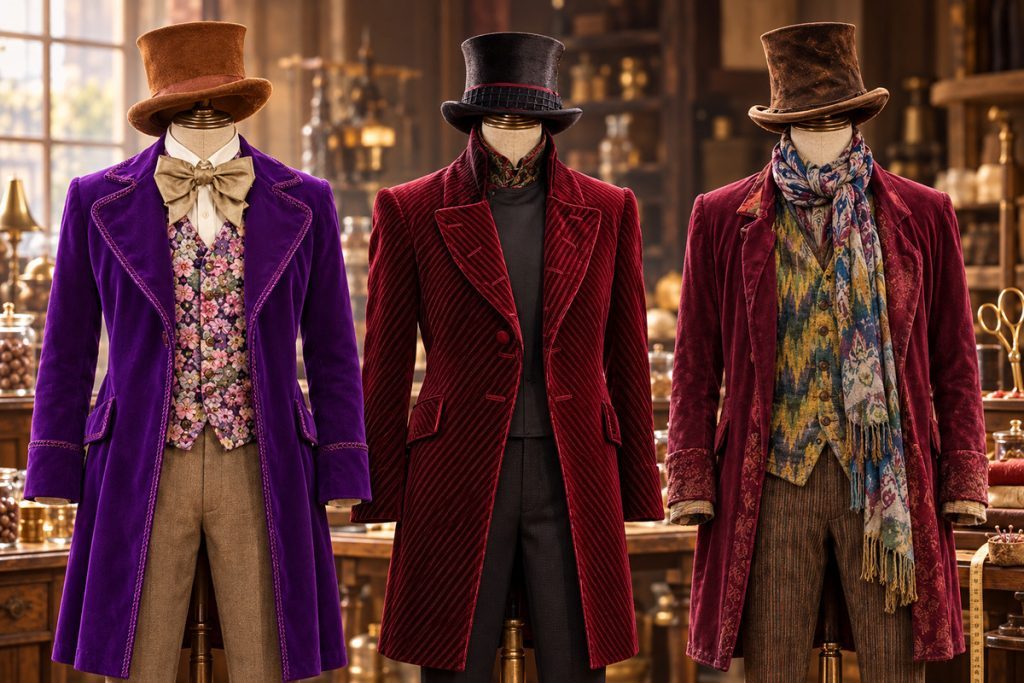
A top hat connects Willy Wonka’s movie costumes, but the clothes beneath it change the character. Gene Wilder’s 1971 look has a bright purple coat and oversized bow tie. Johnny Depp’s 2005 version is darker and sharper, with a black hat and straight bob. Timothée Chalamet’s 2023 outfit combines a burgundy coat with patterned, travel-worn layers.
For your Halloween costume, the useful question is which of those combinations you want to wear. Start with the coat, neckline, and hair together. A candy prop can support the idea, but it cannot explain which Wonka you chose.
Use this comparison to decide where to put your effort, then open the matching outfit guide for its clothing and accessories. The dates below are film release years, not three stages in a single on-screen wardrobe.

1971: purple velvet and a generous bow tie
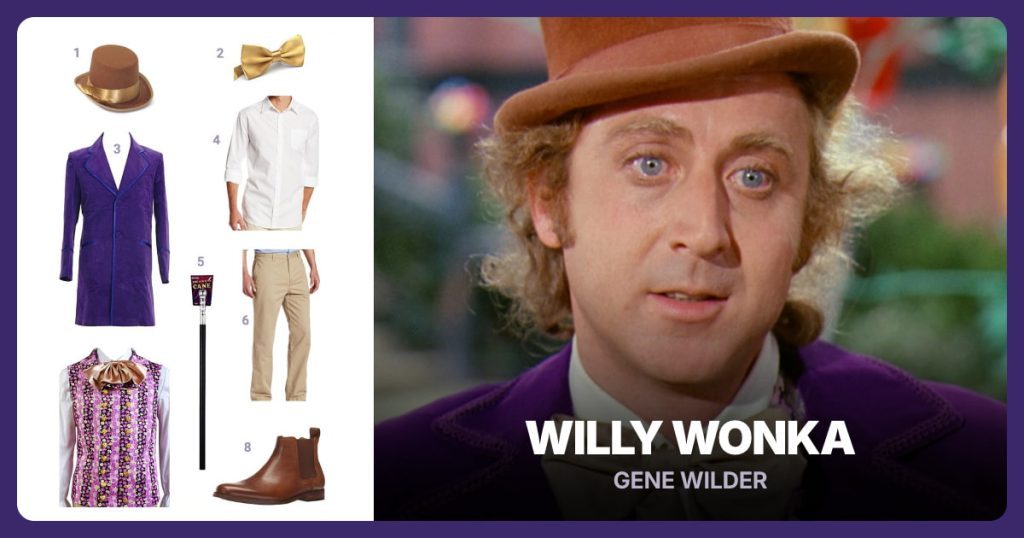
In Willy Wonka & the Chocolate Factory, the purple coat is the largest color statement. The brown top hat, soft curls, patterned waistcoat, and large tan bow tie keep that purple from reading as an ordinary party jacket. The neckline is especially useful: even a close-up shows several of the outfit’s defining details.
Give the bow tie room
Choose a bow with enough width to show against the shirt and waistcoat. A small formal black bow tie changes the balance substantially. For a simple approximation, prioritize the broad tan or gold shape before searching for an exact tiny pattern on the waistcoat.
Keep the coat open so that the patterned front remains visible. A purple blazer can suggest the character when paired with the right hat and neckline, while a longer coat brings the silhouette closer. Decide how exact you want to be before buying a replacement for clothing you already own.
Keep the hair soft around the hat
The loose curls at the sides matter more than a perfectly smooth hairline. Try the hat over your chosen wig or styled hair before finalizing its fit. Look at the whole head from the front: the hat should sit naturally without hiding the bow tie beneath a low brim.
Our Gene Wilder Willy Wonka costume guide brings the main pieces together. If you have limited time, work on the coat-and-bow combination first; a cane can wait until the clothing looks coherent.

2005: a dark collar, striped coat, and precise bob
Johnny Depp’s Wonka in Charlie and the Chocolate Factory has a more enclosed neckline. The dark shirt and patterned neck detail sit inside a burgundy coat with fine stripes. Above them, a tall black hat and a straight, rounded bob create a much more controlled outline than Wilder’s loose curls.
Start with the head and collar
A black top hat alone can belong to many costumes. Pair it with the bob and the dark, close neckline before judging the look. Let a narrow neck detail show rather than adding the oversized tan bow associated with the 1971 outfit.
If you are using an ordinary burgundy coat, keep the rest of the outfit restrained. The color and open front can supply the broad suggestion; avoid covering them with extra bright scarves. For a closer match, inspect the stripe direction, collar shape, and length as well as the color.
Treat gloves as a finishing detail
Dark gloves continue the polished look, but they should come after the coat, hat, and hair. Check whether you can operate your bag and phone with the pair you plan to wear. You do not need to carry a prop all evening for the costume to make sense.
Follow our Johnny Depp Willy Wonka guide for this version. Keep its silhouette together rather than borrowing Wilder’s bow tie simply because it is an easy accessory to find.
2023: the traveler’s coat and layered scarf
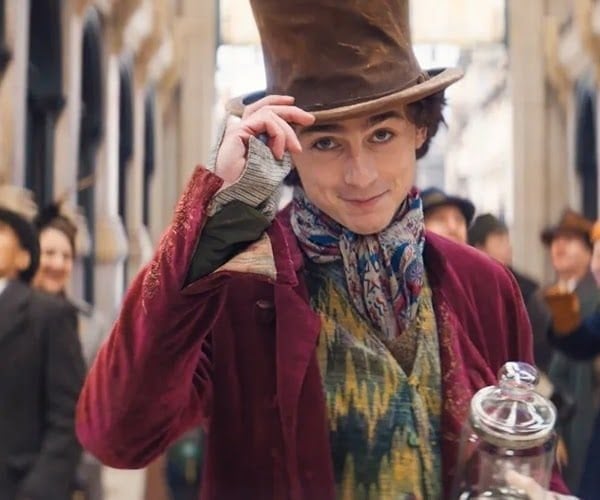
Wonka presents Timothée Chalamet as a young chocolate maker. His burgundy coat, brown hat, patterned scarf, and textured layers suggest a wardrobe assembled over time. The contrast with the 2005 look is useful: both use red-toned coats, but their necklines, hats, and hair give them different personalities.
In the film’s official production notes, costume designer Lindy Hemming describes Wonka as having traveled in his clothes and added layers for different places. Her interview with The Credits also explains the idea that individual garments have their own history.
Let the scarf connect the colors
Choose a soft patterned scarf that brings some of the coat and waistcoat colors together. Arrange it loosely enough to show the layers below. A stiff, oversized bow pushes the outfit toward the 1971 interpretation, while a completely dark closed neckline suggests the 2005 one.
Use texture before extra props
Velvety fabric, patterned knitwear, and a brown hat give you several visible contrasts without needing a complicated handheld accessory. You can suggest a well-used wardrobe through the pieces you choose; there is no need to damage a good coat or make every item look dirty.
Our Timothée Chalamet Wonka guide covers the outfit. Try it with the coat open and closed so you know which scarf and waistcoat details remain visible during the evening.
Choose the combination you can finish well
The strongest starting point is usually a useful piece you already have, paired with the details that belong to the same film.
Build around your best coat
A purple coat naturally points toward Wilder. A burgundy coat gives you a choice: a dark collar and black hat for Depp, or softer patterned layers and a brown hat for Chalamet. Compare the cut as well as the color before deciding.
Spend effort near the face
The hat, hair, and neckline appear together in most party photos. Set those three before worrying about a tiny ring, a detailed cane handle, or a replica wrapper. A convincing upper half is useful even when a crowded room hides the rest.
Keep a group’s reference clear
A group can deliberately wear all three Wonkas. Let each person keep their own coat, hat, and neckline, and introduce the idea as three movie versions. For a single-film group, choose supporting characters and outfits from that adaptation rather than mixing them accidentally.
Photograph it without the candy
Take one picture with empty hands. If the clothing still communicates your chosen version, the prop is doing a supporting job. Then decide whether a lightweight candy-themed accessory adds enough to justify carrying it.
Open the guide for your chosen Wonka
Each guide follows a different outfit. Use one as your main reference instead of combining three shopping lists.
Willy Wonka (Gene Wilder)
Choose the purple coat, broad bow tie, brown hat, and soft curls of the 1971 look.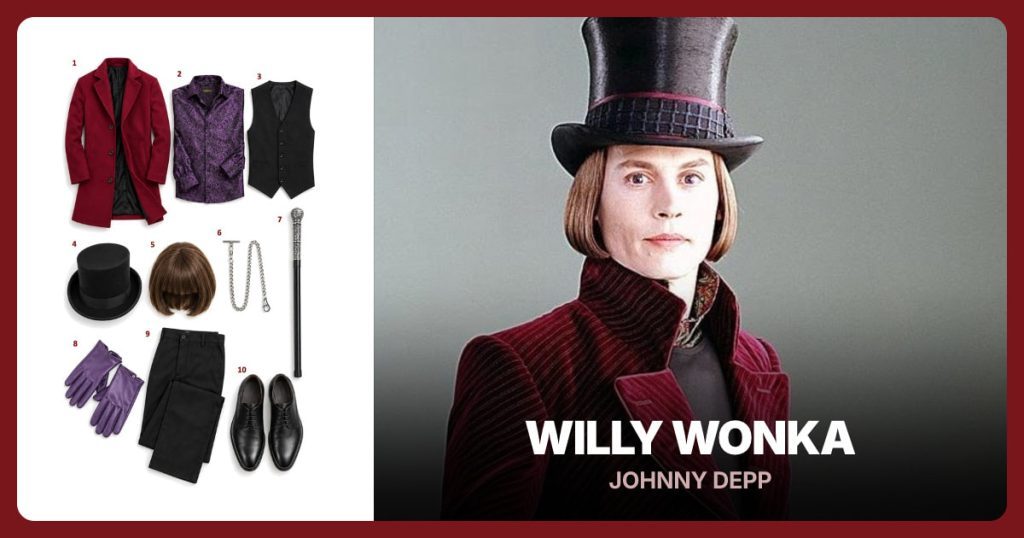
Willy Wonka (Johnny Depp)
Follow the 2005 combination of burgundy coat, black hat, dark neckline, and straight bob.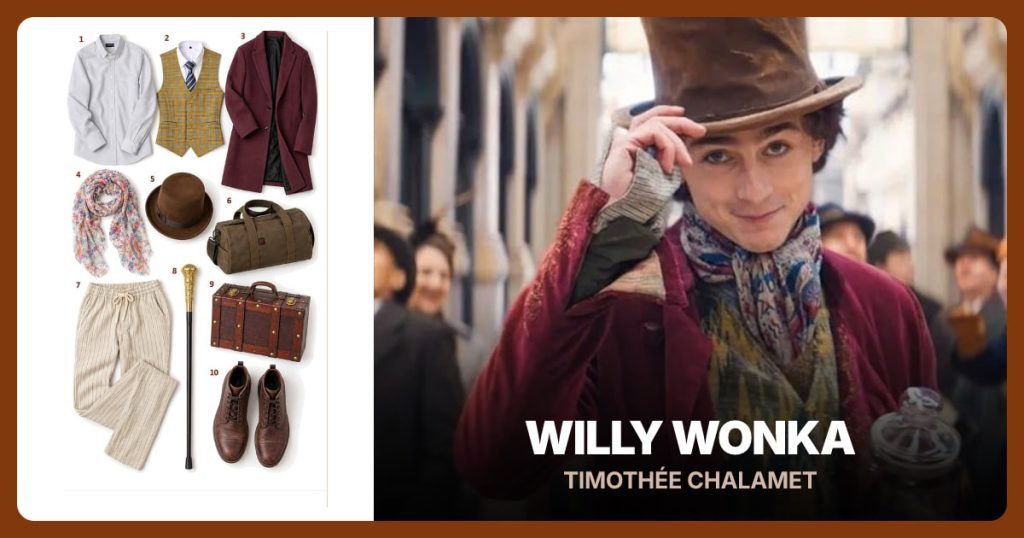
Willy Wonka (Timothée Chalamet)
Build the young Wonka’s burgundy coat, brown hat, patterned scarf, and layered outfit.Try the hat with the whole outfit
A hat that fits over bare hair may sit differently over a wig. Rehearse the final combination before you leave.
Compare the coat, neckline, and head together. Change the detail that pulls you toward the wrong version before adding another accessory.
Willy Wonka costume questions
Is Willy Wonka’s coat always purple?
No. The vivid purple coat is central to Wilder’s familiar 1971 look. Depp’s version uses a dark burgundy striped coat, and Chalamet’s young Wonka wears a burgundy velvet coat. Choose your reference before shopping by color.
Which version wears the large bow tie?
The oversized tan or gold bow tie belongs to the familiar Gene Wilder outfit. It is one of the quickest ways to distinguish that neckline from Depp’s dark collar or Chalamet’s patterned scarf.
Can I use the same hat for all three?
It can suggest Wonka broadly, but it loses a useful distinction. Wilder and Chalamet use brown hats in these looks, while Depp’s is black. Compare the crown, brim, and band as well as the color.
Do I need a wig?
Only if you want it to supply a missing part of the silhouette. Soft curls, a straight bob, and the young Wonka’s looser hair frame the hat differently. Try your own hair first, then decide what the outfit still needs.
Can a purple blazer work instead of a long coat?
Yes, as a simplified Wilder-inspired outfit. Keep the brown hat, large tan bow, and patterned waistcoat together. A longer coat brings the overall shape closer, but the neckline can do useful work with a shorter jacket.
Are the years the same as Wonka’s age or story timeline?
No. They are the release years of the films being compared. The 2023 film tells a young Wonka story; this article is comparing costume interpretations rather than establishing one continuous wardrobe timeline.
Can I mix details from the different movies?
You can make a personal Wonka outfit, of course. If your aim is one recognizable film version, keep its hat, hair, and neckline together. Those choices explain the reference more clearly than a mixture of familiar props.
What should I prioritize on a small budget?
Use the coat you can obtain or reuse, then match its version’s neckline and hat. Photograph that combination before buying small accessories. Spend on the missing detail that changes the whole look, rather than filling every slot on a list.
Film and costume references
The film identities and production context come from these studio and industry sources. Clothing comparisons and Halloween adaptation advice are Costume Wall’s editorial analysis.
The earlier films
- Warner Bros. Post Production Creative Services: Willy Wonka & the Chocolate Factory (1971) — the original film’s identity and restoration record.
- Warner Bros.: Charlie and the Chocolate Factory production notes — the 2005 film, Depp’s role, and production context. Spanish-language archive.
The young Wonka’s wardrobe
- Warner Bros.: Wonka production information — cast, release information, and Hemming’s explanation of the traveling wardrobe, especially pages 24–25.
- The Credits: Lindy Hemming on dressing Wonka — a firsthand costume-design interview.
Make the clothes tell the same story
Wilder’s bright coat and bow, Depp’s dark collar and sharp bob, and Chalamet’s layered scarf all begin with a top hat and end somewhere different. Choose the combination that appeals to you, then keep its strongest details visible together.
Before buying your final prop, take a photo in the coat, hat, and finished neckline. That picture will tell you whether the costume needs a better main piece, a small adjustment, or simply a ticket to the party.