





Wednesday Addams can walk into a scene in a plain collared dress, a striped school blazer, or a cloud of black ruffles and still look like Wednesday. That consistency makes her wardrobe interesting. The clothes change with the adaptation, the setting, and her age, while a few stubborn details keep the character intact.
This is a look at the major screen versions and the clothing choices that distinguish them. We’ll move from the 1960s television series through the 1990s films and animated movies to Netflix’s Wednesday, including Seasons 1 and 2. Along the way, we’ll separate visible costume details from our own styling interpretation, then point you toward the Costume Wall guides that fit.
One character, several wardrobes
These are the main visual stages covered here, rather than an exhaustive list of every Wednesday performance.
1964–1966: the television dress
Lisa Loring’s Wednesday belongs to the black-and-white television household. A dark dress, a bright collar, and two braids give the character a small, orderly shape beside her more imposing relatives. The Television Academy’s series history identifies the original cast and the show’s 1964 debut.
1991–1993: Christina Ricci’s Wednesday
The two films make the familiar dress-and-braids image a strong vehicle for Ricci’s deadpan performance. Paramount’s pages for The Addams Family and Addams Family Values confirm the films, dates, and performer.
2019–2021: the animated silhouette
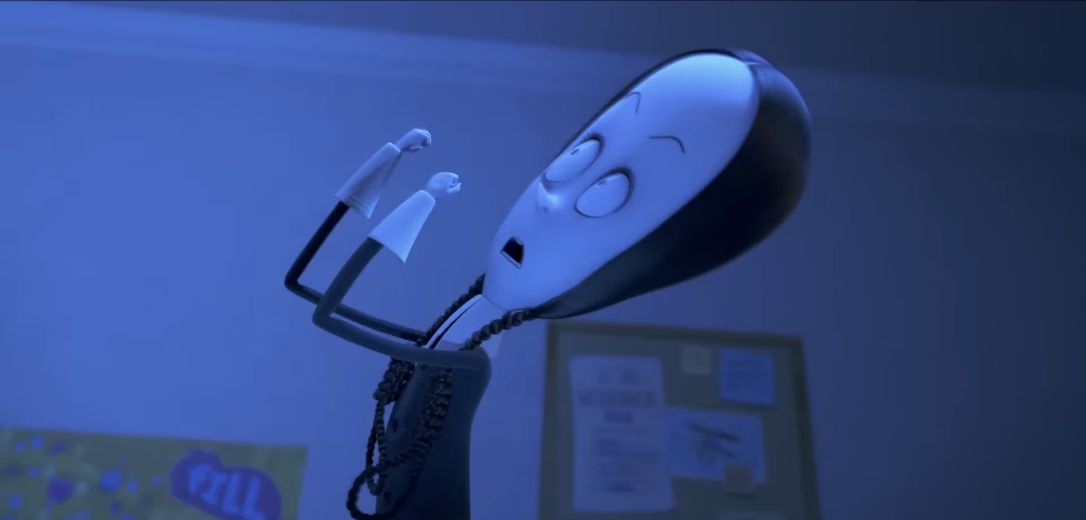
The animated films take Wednesday into a world where body shapes, braids, and clothing can be exaggerated as part of the drawing. The 2019 film’s official Amazon MGM Studios trailer is a useful visual reference for its sharply stylized version.
2022–2025: a wardrobe of her own
Jenna Ortega’s Wednesday becomes the center of a school mystery. She needs clothing for lessons, investigations, downtime, and formal events. The signature palette survives, but the single familiar dress expands into a wardrobe. Netflix’s costume coverage gives us firsthand explanations for several of those decisions.
The classic dress: neat clothes, unsettling company
The white collar does a surprising amount of work.
Why the collar matters
A white collar creates a clear boundary between Wednesday’s face and her dark dress. It draws the eye upward and makes the neckline readable even when the rest of the outfit falls into shadow. Together with the braids, it gives her a tidy, almost school-picture appearance. The joke is that this carefully dressed child belongs to the Addams household.
Look closely at the collar before calling every version a Peter Pan collar. A Peter Pan collar has rounded edges; a pointed shirt-style collar makes a sharper shape. Both appear in Wednesday-inspired clothing, but they aren’t interchangeable when you’re comparing a particular screen reference. The Ricci portrait shown here has visibly pointed ends.
The 1960s version and the film version
Loring and Ricci share the dress-and-braids vocabulary, but a performance changes how we read it. A neat dress can feel like ordinary childhood clothing in one scene and deliberately severe in another. That is our interpretation of the effect, rather than a claim that the costume departments used the same pattern or materials.
Black-and-white television adds another distinction: we see value, contrast, and shape before we see color. A dark garment in a monochrome still doesn’t establish its exact original hue. For a Halloween interpretation, black clothing gives the familiar effect; for a historical comparison, describe what the reference actually shows.
Animation makes the outline part of the character
In a drawn world, a braid or collar can become a stronger graphic statement.
The Wednesday shown in the 2019 official trailer has an elongated, deliberately stylized outline. Her pale face, small dark outfit, and long braids read as contrasting shapes. The braids themselves end in conspicuously looped forms, adding a macabre joke to a familiar hairstyle. Those details belong to this animated design; they aren’t a universal requirement for every Wednesday costume.
A live-action dress has to move on a performer’s body. Animation can push proportions much further. The result is useful to study even if you’re making a wearable interpretation: recognition can depend on the arrangement of a few shapes rather than the number of accessories.
This is where copying every detail can become less helpful than identifying the important ones. A human-sized costume can keep the narrow dark dress, strong collar contrast, and two distinct braids without trying to reproduce a cartoon’s body proportions. Choose the animated version because you enjoy its design, then decide which features translate into clothing.
The same principle applies to an illustrated reference generally. Separate the garment from the drawing style. A tiny waist, exceptionally long neck, or exaggerated head isn’t a clothing instruction. The useful questions are where the collar sits, how the sleeves meet the dress, and which areas stay dark.
Nevermore gives Wednesday a uniform she can resist
The school outfit makes her difference visible inside a shared dress code.
Three Ways to Stay in Black
Structure replaces the single dress
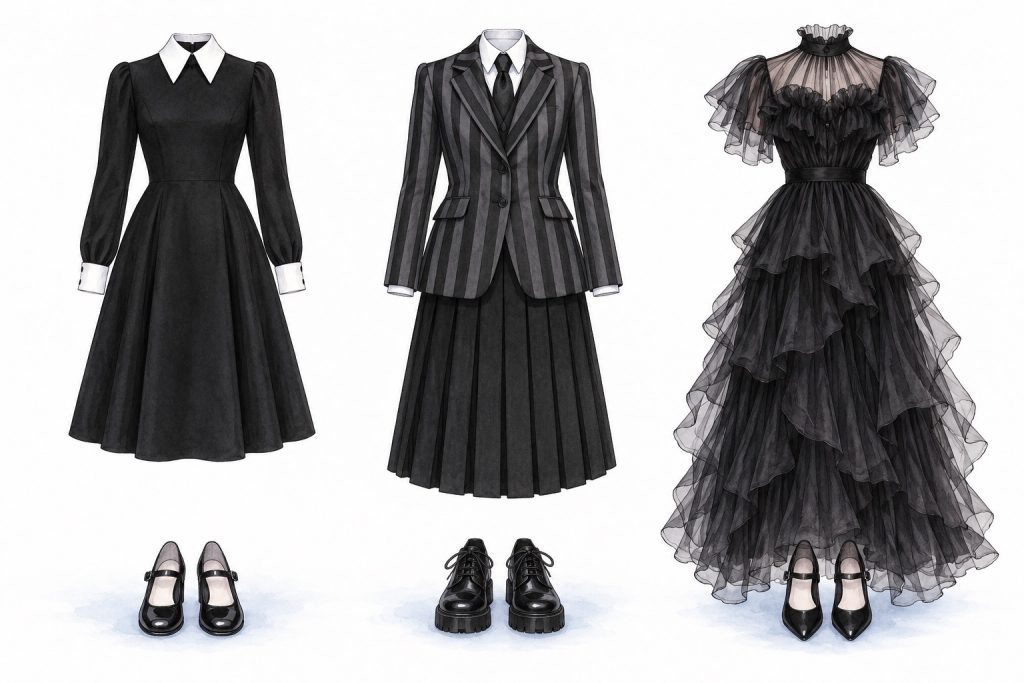
In Netflix’s Season 1 costume interview, Colleen Atwood explains the choice to give Wednesday a gray-and-black version of Nevermore’s uniform instead of the purple-and-white version worn by other students. The point is visible immediately: she belongs to the institution, but she isn’t absorbed into its color scheme.
The blazer changes the outfit’s architecture. Lapels frame the neckline differently from a dress collar. Vertical stripes repeat down the torso, while the pleated skirt supplies a different rhythm below. The shirt and tie introduce layers. You can still recognize Wednesday through the dark palette and braids, but the clothes now place her within a school.
Ordinary clothes make room for ordinary scenes
The same interview describes Atwood’s use of casual clothing, including an oversized sweatshirt, so Wednesday isn’t always in a dress or uniform. That matters for a series with scenes outside lessons and formal family gatherings. A recurring character needs clothes that can change with what she is doing.
For an everyday interpretation, the most useful lesson is restraint. A black-and-white striped layer, dark trousers, and plain shoes can borrow the visual language without becoming a school costume. For a Nevermore costume, the blazer, shirt, tie, and skirt work together as the specific reference. Decide which aim you have before adding a crest or other school detail.
The dance dress changes the texture, not the character
Black can be crisp, heavy, transparent, or light in motion.
Why the Rave’N look feels different
The Season 1 dance dress replaces the familiar bright collar with a much more elaborate black neckline and a layered, fluttering outline. Instead of relying on white against black, it uses opaque and sheer areas within the same color. The fabric moves around Wednesday as she dances, giving the dress a different presence from the orderly school uniform.
The Television Academy’s costume feature discusses Atwood’s work and the Alaïa dress selected for the dance. Ortega’s own outfit discussion supplies another firsthand view of the wardrobe. Those are stronger references than assuming an online dress labeled “Wednesday” matches the scene.
Ruffles are a silhouette choice
A ruffle is a gathered or folded strip that adds volume along an edge. Several tiers make the skirt’s outline fuller and create repeated horizontal breaks. A smooth black skater dress and a tiered sheer dress may share a color, but they behave very differently in a photograph and in motion.
When comparing fabrics, keep appearance separate from fiber content. A screen image may show transparency, shine, a dense surface, or a floating layer. It usually can’t prove whether a fabric is silk, nylon, polyester, or a blend. Describe the visible effect first. For a costume interpretation, layered sheer ruffles are more useful guidance than an unsupported claim about the original material.
Season 2 adds a detective’s outer layer
The wardrobe grows while Wednesday’s relationship with clothing stays stubbornly her own.
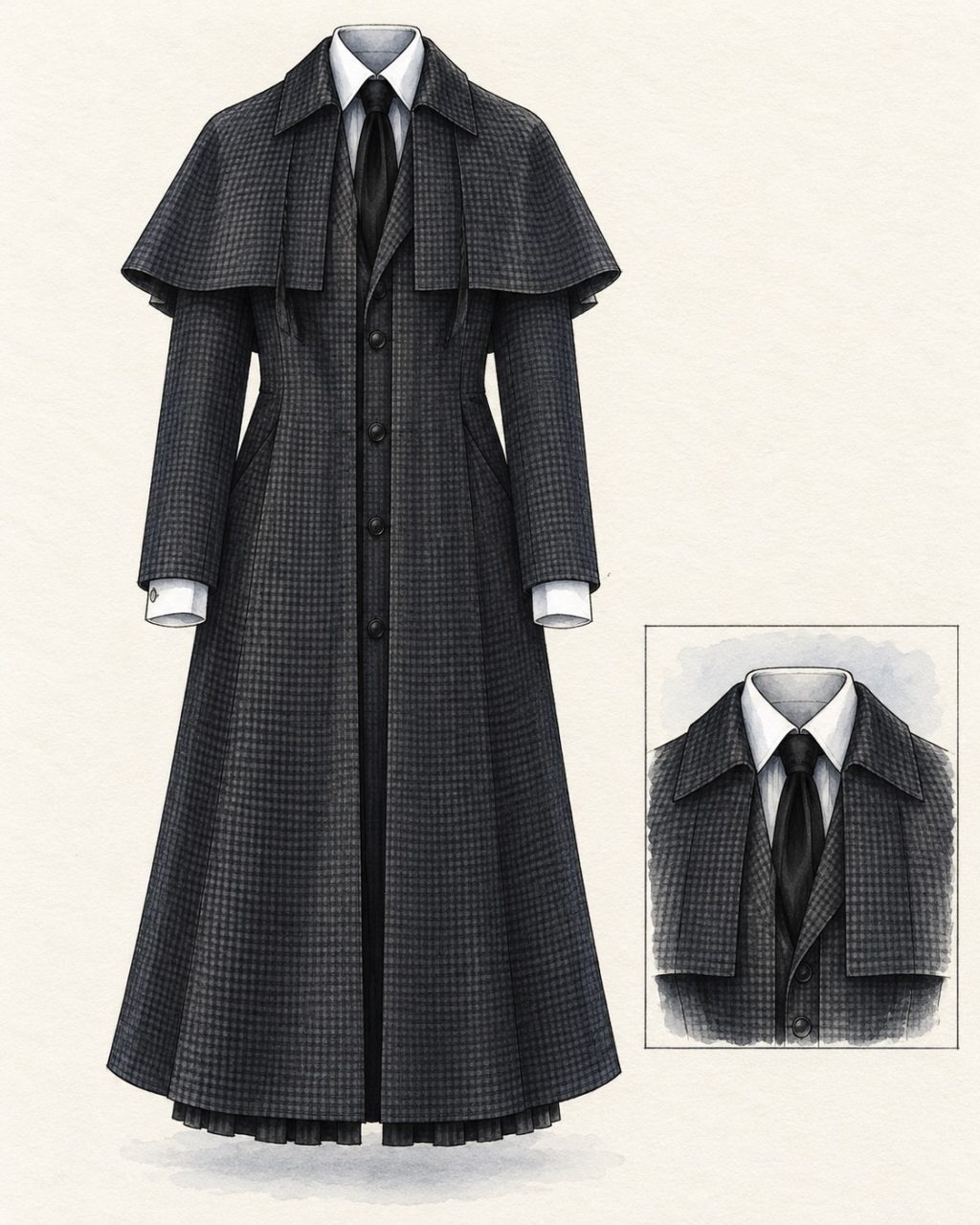
Netflix’s Season 2 production deep dive describes the costume team’s effort to refine Wednesday’s monochrome wardrobe without turning her into someone preoccupied with fashion. It also identifies the distinctive 1960s-style detective coat Ortega wears through much of the season, with its flap around the upper body.
The outer layer changes which part of the costume you notice first. With a coat on, the shoulder shape, front opening, and hem become the main outline; a collar or striped layer beneath can become a smaller clue. That’s a different visual problem from a dress shown on its own. A costume can have the right inner pieces and still read differently once a bulky coat covers them.
The season’s gala provides another formal setting, and the same production feature discusses Wednesday’s elaborate event look and braided hairstyle. The costume designers’ video breakdown lets you examine the work more closely. These event clothes should be treated as their own outfits, rather than folded into the everyday school uniform.
For a style comparison, the interesting question is how far a look can move from the original dress while keeping the character legible. A dark palette helps, but it isn’t the whole answer. The face framing, controlled outline, and relationship between plain and elaborate surfaces also matter. That is the visual argument of this article, rather than a statement that one designer’s intention applies to every adaptation.
Four details that explain the evolution
Look at these separately before deciding that two outfits are the same.
1. The neckline
A bright collar creates a small, readable focal point. A shirt, tie, and lapels build several frames around the face. A sheer formal neckline changes the balance again. “Black dress” is too broad a description to capture those differences.
2. The shape below the waist
A restrained A-line skirt widens gradually; a pleated school skirt carries repeated folds; a tiered formal skirt adds volume in layers. The skirt’s outline tells you more than the color alone. Compare the hem and the amount of fullness before choosing a base garment.
3. The surface
Smooth dark fabric can read as a single block. Stripes divide it into vertical lines. Sheer sections reveal different values beneath, and ruffles catch light along their edges. These are visible design differences, even when every piece is black.
4. The framing around the face
The braids connect many versions, but their length, thickness, placement, and accompanying fringe change the frame. You can borrow the hairstyle without copying a performer’s face or body. Check the selected outfit reference before treating one wig as accurate for every era.
Where our Wednesday guides fit
Choose the guide for the outfit direction you want. The article explains the changes; the guides help you assemble the clothing.
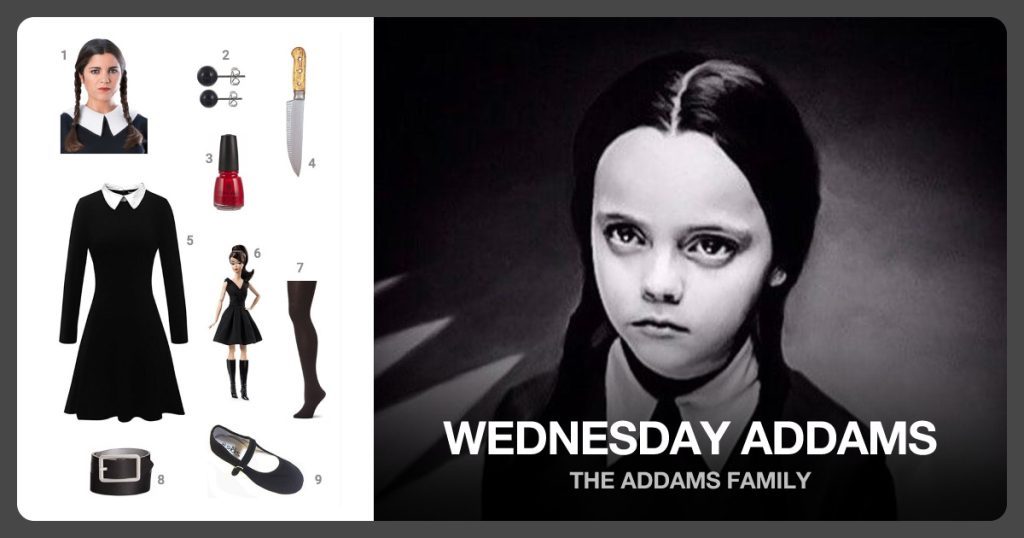
Wednesday Addams
Start with the classic black dress, contrasting white collar, dark tights, and Mary Janes. The familiar braids complete this traditional Wednesday interpretation.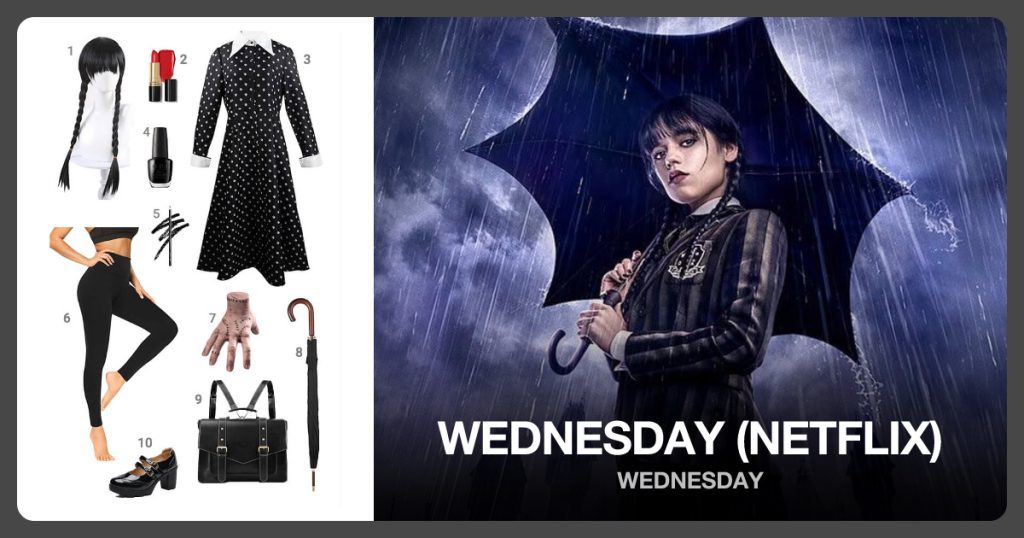
Wednesday (Netflix)
Our Netflix collared-dress interpretation adds contemporary accessories and a Thing prop. Use it for that outfit direction; the school uniform and dance dress are separate looks.What happens when the costume becomes everyday style?
The same clothing cues can become much quieter.
A Study in Black
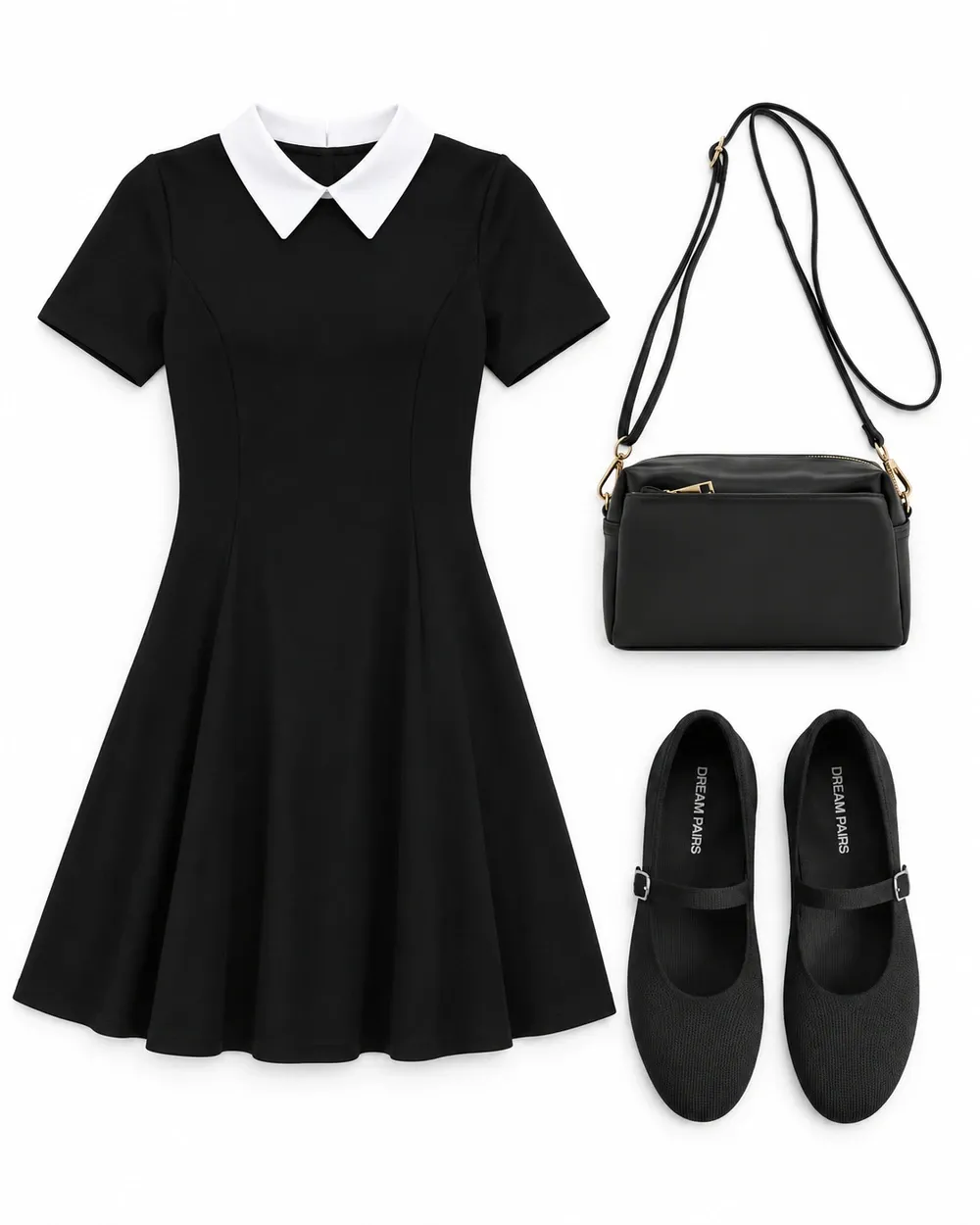
Our Wednesday Addams inspired-outfit guide uses the collar, monochrome contrast, and striped layers as starting points for regular clothes. The dress above is one of its complete looks. The guide also offers a graphic-tee outfit and a striped-shirt outfit with trousers.
These are contemporary styling interpretations, not additional screen adaptations. That distinction keeps the history clear. An everyday collared dress can refer to Wednesday without reproducing one actor’s costume, and a striped shirt can suggest the school wardrobe without claiming to be a Nevermore uniform.
Try one strong cue first. A white neckline against black may be enough; a striped outer layer might do the job instead. Adding the dress, braids, dark makeup, props, and every accessory moves the result toward a complete costume. Both approaches can work, but they serve different days.
Wednesday’s wardrobe questions
Does Wednesday always wear a black dress with a white collar?
No. It is a familiar signature look, but Netflix’s series includes a school uniform, casual clothes, outerwear, and formal outfits. Choose a particular scene or wardrobe direction before assembling a costume.
Is the Nevermore uniform purple?
The Season 1 costume interview describes Wednesday’s uniform as gray and black, distinguishing it from the purple-and-white uniforms worn by other students. A general Nevermore outfit and Wednesday’s personal uniform are different references.
Is every white collar a Peter Pan collar?
No. Peter Pan collars have rounded edges. A pointed collar has a sharper outline. Look at the exact reference rather than using the term for every contrasting white neckline.
Does the classic guide recreate the Rave’N dress?
No. The classic and current Netflix guides are collared-dress interpretations. The Rave’N look depends on its sheer sections, ruffled shape, and formal styling, so it needs a separate outfit reference.
Can I tell the original fabric from a still?
You can often identify visible effects such as transparency, shine, folds, or texture. Those observations don’t necessarily establish fiber content or the exact fabric name. Use a production source when you need that level of detail.
Can I use Wednesday’s style without wearing a costume?
Yes. Our inspired-outfit guide translates the white collar, dark base, and monochrome stripes into ordinary clothing. Choose the cue you like and use your own hair, shoes, and everyday accessories.
Which part of Wednesday’s outfit should I choose first?
Choose the neckline and main clothing shape from one scene. A pointed white collar over a simple dress gives a different starting point from a striped school blazer or a ruffled formal dress. Once that choice is clear, use the same reference for the shoes, outer layer, and hairstyle.
Can I combine the classic dress with Nevermore accessories?
You can make a personal Wednesday-inspired outfit that mixes references. For a specific adaptation or scene, keep the dress, collar, and school details consistent with that reference. The combination can be recognizable without being an exact screen costume.
Do I need to copy Wednesday’s hair to wear an inspired outfit?
No. For everyday styling, the white collar, dark clothing, or monochrome stripes can carry the reference on their own. Keep your own hair and choose clothes you enjoy wearing. A costume recreation can use the hairstyle as an additional cue, but an inspired outfit has more room for personal choices.
Sources and further viewing
Production history and attributed design decisions come from these sources. The comparisons of shape, contrast, and styling are Costume Wall’s editorial analysis.
Classic adaptations and design history
- Television Academy: The Addams Family — the original television series and cast.
- Paramount: The Addams Family and Addams Family Values — the 1991 and 1993 films and Ricci’s role.
- Amazon MGM Studios: 2019 official trailer — the animated character design.
- Television Academy: Wednesday’s Dark Matters — Atwood’s costume work and the dance dress.
The Netflix wardrobe
- Netflix: How Wednesday Made the Little Black Dress Even More Goth — the Season 1 uniform and casual wardrobe.
- Netflix: Ortega discusses her Wednesday outfits — firsthand wardrobe commentary.
- Netflix: Inside the World of Wednesday Season 2 — the detective coat and gala styling.
- Netflix: Behind the Fashion of Wednesday — the Season 2 designers’ visual breakdown.
Choose a Wednesday, then choose the clothes
Wednesday’s style stays recognizable because its strongest clues can survive a change of setting. A collar frames the face, braids establish a familiar outline, and dark clothing connects a simple dress to more complicated tailoring. The adaptations change what those details do: childhood order, film severity, school resistance, or elaborate formalwear.
For your own costume, begin with the version you enjoy most and one clear outfit reference. Choose its neckline, skirt shape, and main outer layer before collecting accessories. For everyday style, keep the cue you like and let the rest of the outfit belong to you. The useful lesson is how much character a few deliberate clothing choices can carry.