










A flat head, heavy brow, dark jacket, and a pair of neck bolts: put those together and most people will recognize Frankenstein’s monster. But open Mary Shelley’s novel and you find a very different starting point. Follow the character into television comedy or a newer film and the clothes, hair, proportions, and mood change again.
That makes this a useful Halloween costume question: which monster do you actually want to be? This article follows the literary Creature, the familiar Universal screen design, Herman Munster’s friendly variation, and Guillermo del Toro’s 2025 interpretation. We’ll separate documented history from our costume-design analysis, then point you toward the relevant Costume Wall guides.
Shelley’s Creature starts with unsettling contrasts
The familiar Halloween face is one interpretation of the character, rather than a complete description of the novel.
The hair and skin tell a different story
In Chapters 4 and 5 of Shelley’s Frankenstein, Victor makes a being about eight feet tall. The creation scene describes yellow skin, flowing black hair, very white teeth, watery eyes, and dark lips. Victor has selected features he considers beautiful, yet their combination horrifies him. A flattened skull and neck bolts do not appear in that description.
For a costume inspired by this passage, long dark hair changes the whole outline. It draws the eye down beside the face instead of emphasizing a square top. A gaunt face and muted yellowish complexion suggest another direction from the bright green masks commonly sold for Halloween. You can keep the tragic, uncanny impression without copying the later screen shorthand.
Clothes become an interpretation
The creation passage gives stronger guidance for the body and face than for a complete outfit. A cloak, shirt, or rough outer layer can help your interpretation feel coherent, but it should not become an invented claim that Shelley supplied one definitive Halloween costume. The clothing you choose is part of translating prose into a visible person.
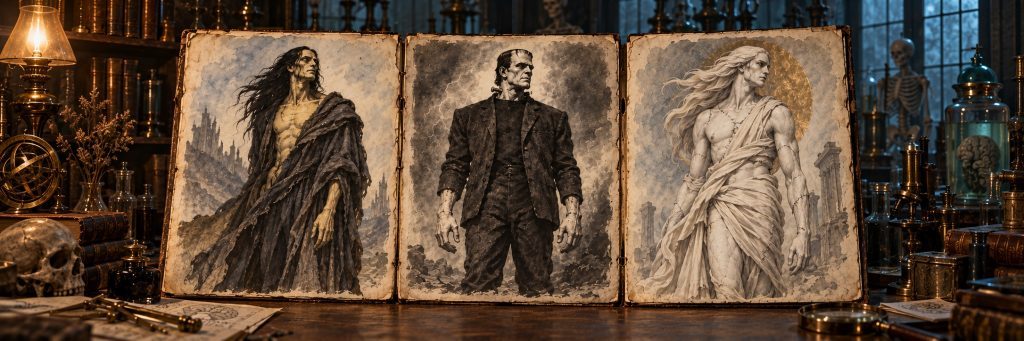
Our opening artwork takes that approach: it contrasts a long-haired literary concept with a blockier screen-inspired figure and a pale sculptural concept. It is an original editorial illustration, not an image of three actors or a reconstruction of three production costumes. Use it to understand the difference in emphasis; use the source you choose for exact details.
1931: the head becomes an instantly readable symbol
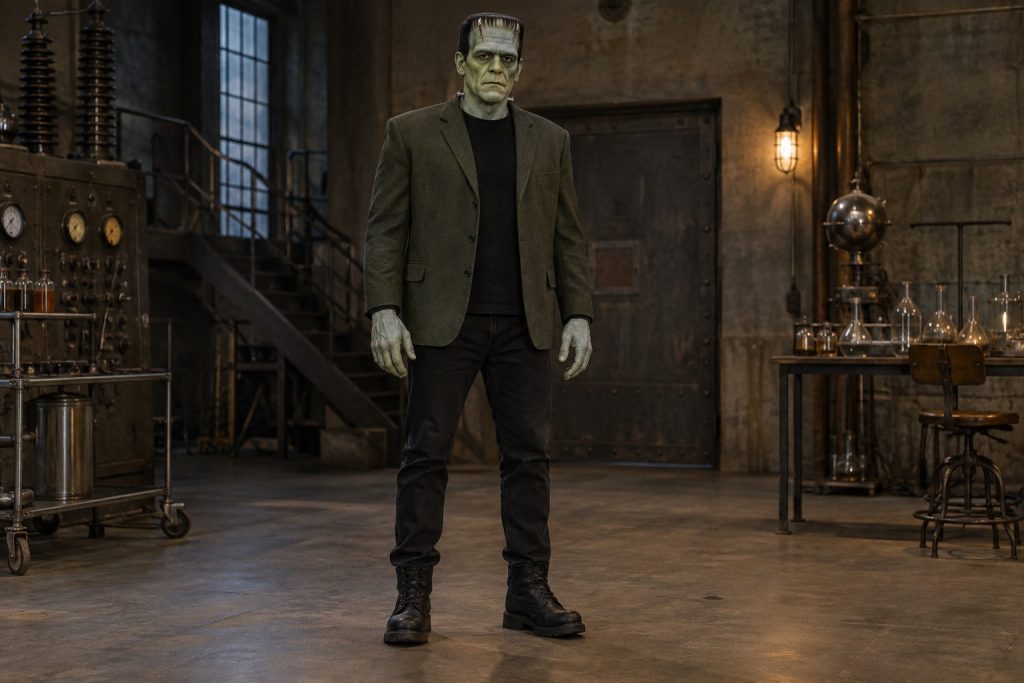
The National Library of Medicine’s Frankenstein exhibition credits makeup artist Jack Pierce with the enduring visual impact of Boris Karloff’s film monster. Universal’s 1931 Frankenstein established the familiar flattened head, surgical scars, and neck bolts, alongside Karloff’s portrayal of a speechless Creature.
Those features organize the face into bold shapes. The flat upper edge, dark hair, and heavy brow can still read in a small photograph. The neck details extend the design below the jaw, so the character does not depend entirely on facial expression. Compared with the flowing hair described in the novel, the head feels deliberately built and sharply outlined.
The jacket and boots support that impression. In our guide illustration, the fairly plain clothes give the unusual head room to lead. The boots add weight at the bottom, while the dark shirt leaves a clear boundary beneath the face. These are our observations about the pictured outfit, rather than claims about the original film’s tailoring or manufacturing materials.
The detail to protect: Keep the head shape visible. A hat, long loose wig, or very busy collar can cover the features that make this version easy to identify. If you choose a simplified costume, a coherent head-and-neck design does more work than a collection of unrelated laboratory props.
Green skin is not a complete version label
Color can suggest the monster, but it cannot tell you which interpretation you’re looking at.
Look beyond the face color
A green face with long hair, a smooth round head, and a flowing robe has a different outline from a green face with a flat skull and a square jacket. The color connects them at a broad Halloween level; the proportions tell different stories. That is why choosing face paint before choosing a reference can leave the rest of the costume uncertain.
Start with the hairline, brow, jaw, neck, and outer clothing. Then decide which color treatment belongs to your intended look. A deliberately playful green monster is a perfectly clear party idea when you present it as that. It does not need to become a claim of literary accuracy.
A black-and-white image cannot supply every color
A grayscale still shows tonal contrast, not a reliable paint chart. Lighting and photographic reproduction can change how dark a jacket, face, or hair looks. Save a clear front view for shape, and seek a documented color reference when exact production color matters to your project.
Keep your own costume photograph separate from your historical evidence, too. Our olive-jacket illustration demonstrates a wearable guide interpretation. Its jacket color is useful for that outfit, but it does not establish the color of Karloff’s original screen wardrobe.

Herman Munster turns the monster shape into a family character
Fred Gwynne’s Herman belongs to The Munsters, rather than being another appearance by Victor Frankenstein’s Creature. Sony’s Masterworks Broadway biography of Gwynne describes the Frankenstein-inspired character’s sentimental nature and neck bolt. The original series ran from 1964 to 1966.
For a costume, that change of character is more than a name on a card. The familiar brow and large outline remain, but a friendly expression and recognizable suit make the figure feel like someone arriving home rather than escaping a laboratory. The clothes have a social role: they help turn the monster into a person with an ordinary life.
Our Herman guide uses his brown suit and broad monster face as its starting point. Choose that route when you want the television character specifically. If you are pairing him with another costume, the most useful question is who belongs in Herman’s world, rather than which random monster also happens to have green makeup.
The detail to borrow: Let expression and posture finish the outfit. A warm smile gives the same imposing brow a different effect. A photograph that shows the jacket and stance will explain Herman better than a tightly cropped picture of a generic monster mask.
2025: del Toro’s Creature moves toward sculpture
A newer design can revisit the tension between beauty and damage without repeating the square-headed icon.
The makers describe a marble-statue direction
In Netflix’s firsthand production feature, Guillermo del Toro explains his marble-statue inspiration for the Creature played by Jacob Elordi. Makeup designer Mike Hill helped develop the appearance. The account connects the assembled body with casualties of the Crimean War, while retaining a deliberately beautiful quality.
That starting point changes what you look for in a costume reference. A sculptural face and pale body invite attention to contours and seams rather than a flat hairline and a green mask. Cloth wrapped or draped around the figure creates flowing edges. The emotional impression can remain disturbing, but the visual vocabulary is different.
Choose a moment, not just a film title
For an adaptation-specific costume, decide which scene you want to represent. The body, clothing coverage, posture, and visible damage can change across a story. Combining everything you remember from a film may produce a costume that belongs to no particular moment.
Use one clear primary reference for the outfit and a second view to understand the face. If you are making a personal sculptural interpretation, say so and let that idea guide your choices. The pale figure in our cover is an illustrative design concept; it should not be used as an exact shopping diagram for Elordi’s screen costume.
The Bride adds a different kind of silhouette
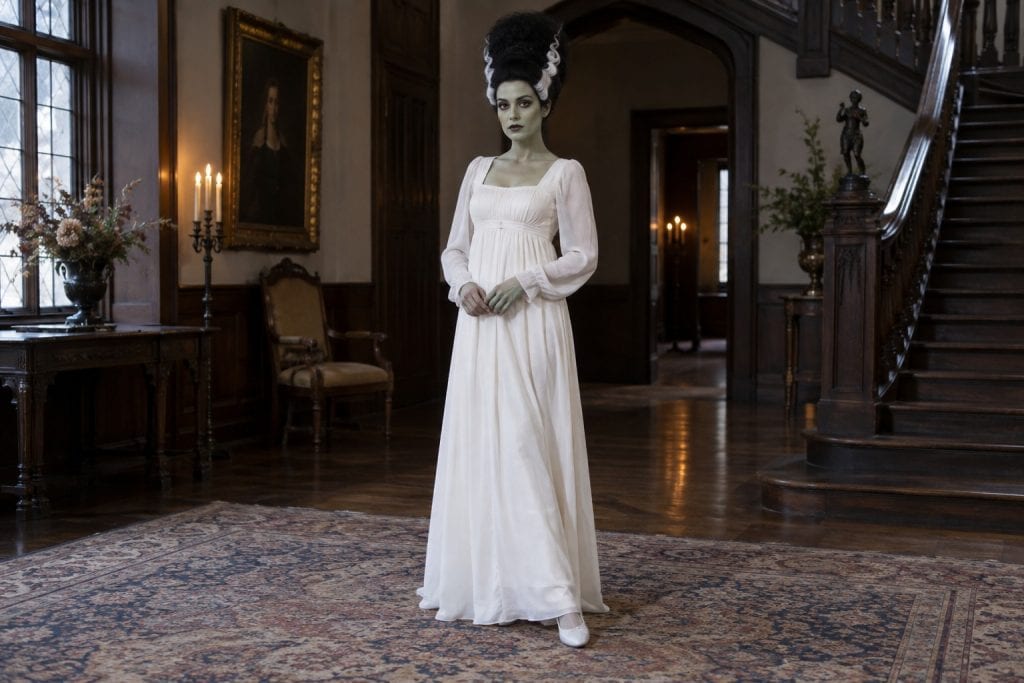
Peacock’s overview of the Universal films identifies Elsa Lanchester as the Bride in the 1935 sequel. Her famous hair provides an especially useful contrast with the monster’s flattened head: height and white streaks replace the low, squared top edge.
Our Bride guide illustration makes that relationship easy to see. The white gown forms a broad light area beneath a dark raised hairstyle. The arms and neckline keep the top of the outfit visually open, leaving the hair as the main identifying feature. A small white streak lost behind a hood would not have the same effect.
For a pairing, you do not need both costumes to compete for detail. A simple dark monster outfit and a light Bride-inspired gown create an immediate relationship. Keep each head shape distinct and let the contrast do some of the work. The original guide offers several wearable interpretations; choose the one that suits your planned look rather than treating every white dress as the same costume.
Keep the characters separate: The Bride is a related film character, not a female version of every Creature adaptation. Pairing her with another interpretation can be a fun personal combination, but label the combination clearly if screen accuracy is your goal.
Choose the guide that belongs to your character
These are existing Costume Wall guides for different roles and interpretations. The classic monster guide offers wearable Halloween options; Herman and Victor follow named characters.
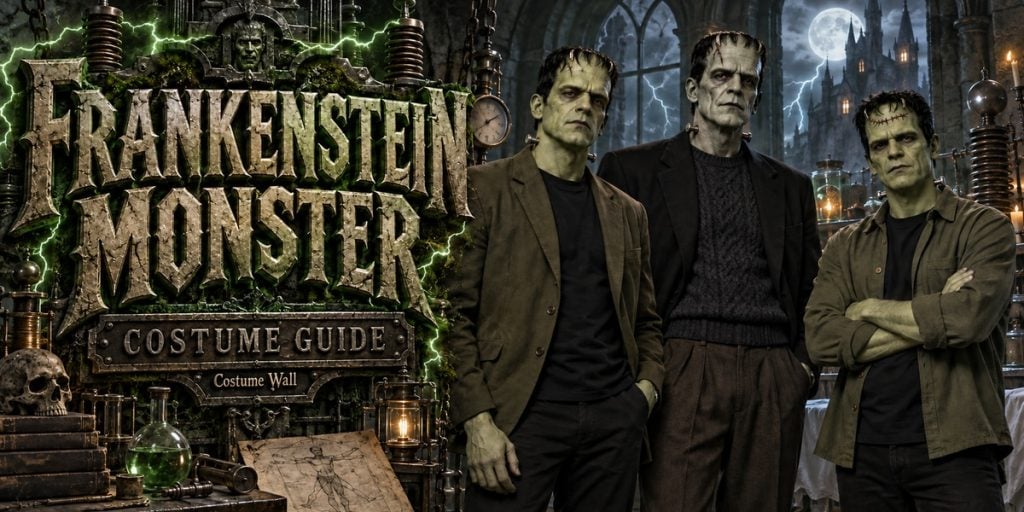
Frankenstein Monster
Classic-inspired monster outfits with a dark base, strong head shape, and practical layering options.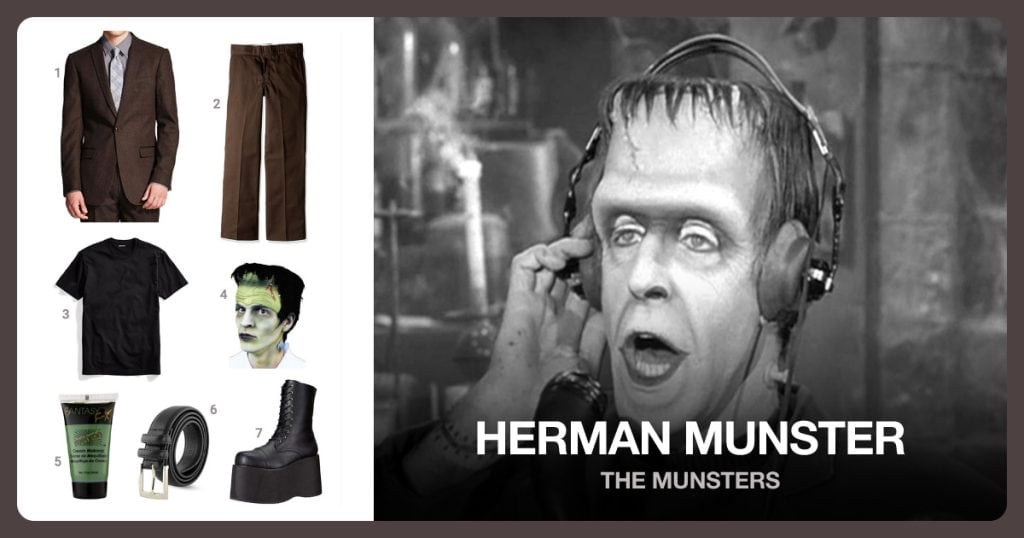
Herman Munster
Herman’s brown suit and broad brow, with the friendly character of The Munsters.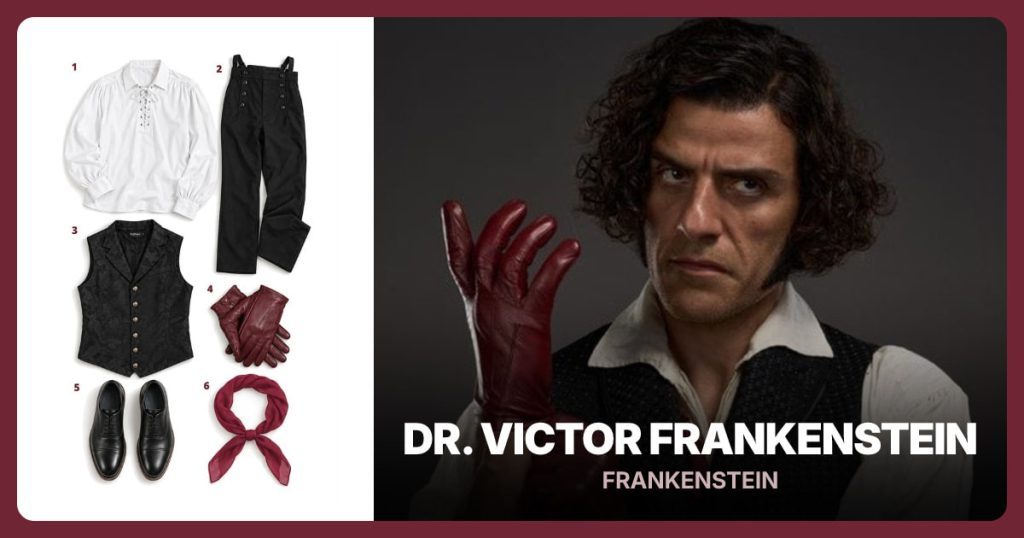
Dr. Victor Frankenstein
Oscar Isaac’s Victor: waistcoat, rolled sleeves, and burgundy details for the scientist.For the white gown and raised streaked hairstyle, see our Bride of Frankenstein guide.
Decide which monster you mean
A few choices made before shopping will keep the costume coherent. You can aim for a particular screen appearance, a literary interpretation, or a playful Halloween monster. Give yourself a clear starting point.
Frankenstein costume questions
Does the novel describe a green, flat-headed monster?
The creation scene describes yellow skin and flowing black hair. The familiar flattened head and neck bolts belong to the later film icon. If you want a novel-inspired costume, begin with the text rather than assuming that a standard green Halloween mask settles the details.
Are Frankenstein and his monster the same character?
Victor Frankenstein creates the Creature. A scientist costume and a monster costume represent different roles, even though casual Halloween labels often shorten the latter to “Frankenstein.” Our Victor guide follows the scientist played by Oscar Isaac.
Is Herman Munster a version of the same Creature?
Herman is a separate character in The Munsters who borrows the recognizable Frankenstein-inspired appearance. His suit, expression, and family-comedy identity distinguish him from the Creature in a Frankenstein adaptation.
Can I mix the classic monster head with modern clothes?
Yes, as a personal Halloween interpretation. A dark jacket and trousers can keep the monster head clear while letting you use clothes you already own. If you call the result an exact film costume, the clothes and smaller details should follow that specific film reference.
Which Costume Wall guide covers the 2025 Creature?
The 2025 guide linked here covers Dr. Victor Frankenstein, not the Creature. Our classic monster guide supplies a different, classic-inspired Halloween route. For Elordi’s Creature, use Netflix’s production feature and your selected scene as references rather than substituting the scientist’s clothing.
Which details make a classic monster costume recognizable?
Start with the flattened head, heavy brow, dark hair, and neck details. A plain jacket and substantial boots support that outline without competing with it. Keep the head and neck visible in your outfit photo; adding more props will not help if the main identifying features are hidden.
What clothes work for a novel-inspired Creature?
The creation passage gives clearer guidance for the Creature’s face and body than for a complete outfit. You might choose a rough shirt, cloak, or worn outer layer to support your interpretation, alongside flowing black hair. Treat those clothing choices as your own translation of the text rather than an exact outfit described by Shelley.
Can the monster and the Bride work as a couples costume?
Yes. A dark monster outfit and a light Bride-inspired gown create a clear contrast, while the flat monster head and raised, white-streaked hairstyle keep the characters distinct. For a classic film-inspired pairing, choose references from the same screen world. Mixing the Bride with a different Creature interpretation can also work as your own Halloween combination.
Can I choose costume colors from a black-and-white film still?
Use the still to study the hairline, clothing shapes, and light-and-dark contrast. It cannot reliably tell you the original colors of the makeup or fabric. If exact production colors matter, find a documented color reference; otherwise choose colors for your Halloween interpretation without presenting them as historical evidence.
Sources behind the comparison
These primary and institutional sources support the history and production details. The costume observations and planning advice are Costume Wall’s analysis. Our own guide illustrations are labeled as interpretations.
The novel and classic films
- Mary Shelley, Frankenstein, via Project Gutenberg: Chapters 4 and 5 for the creation and appearance.
- National Library of Medicine: Transformation of a Monster: Karloff, Jack Pierce, and the 1931 screen design.
- Peacock: Frankenstein films: the 1935 Bride and Elsa Lanchester.
Television and modern adaptations
- Sony Masterworks Broadway: Fred Gwynne: Herman Munster’s character and television context.
- Netflix Tudum: the making of del Toro’s Frankenstein: firsthand Creature-design commentary.
Start with the character, then choose the details
Frankenstein’s monster can be long-haired and tragic, square-headed and imposing, friendly in a suit, or pale and sculptural. Those choices are what make the history interesting, and they also make a costume easier to plan. Pick the interpretation that draws you in, keep its strongest head and clothing features together, and use the relevant guide when you’re ready to assemble the outfit. You’ll end up with a costume that tells a clear story instead of a collection of monster accessories.